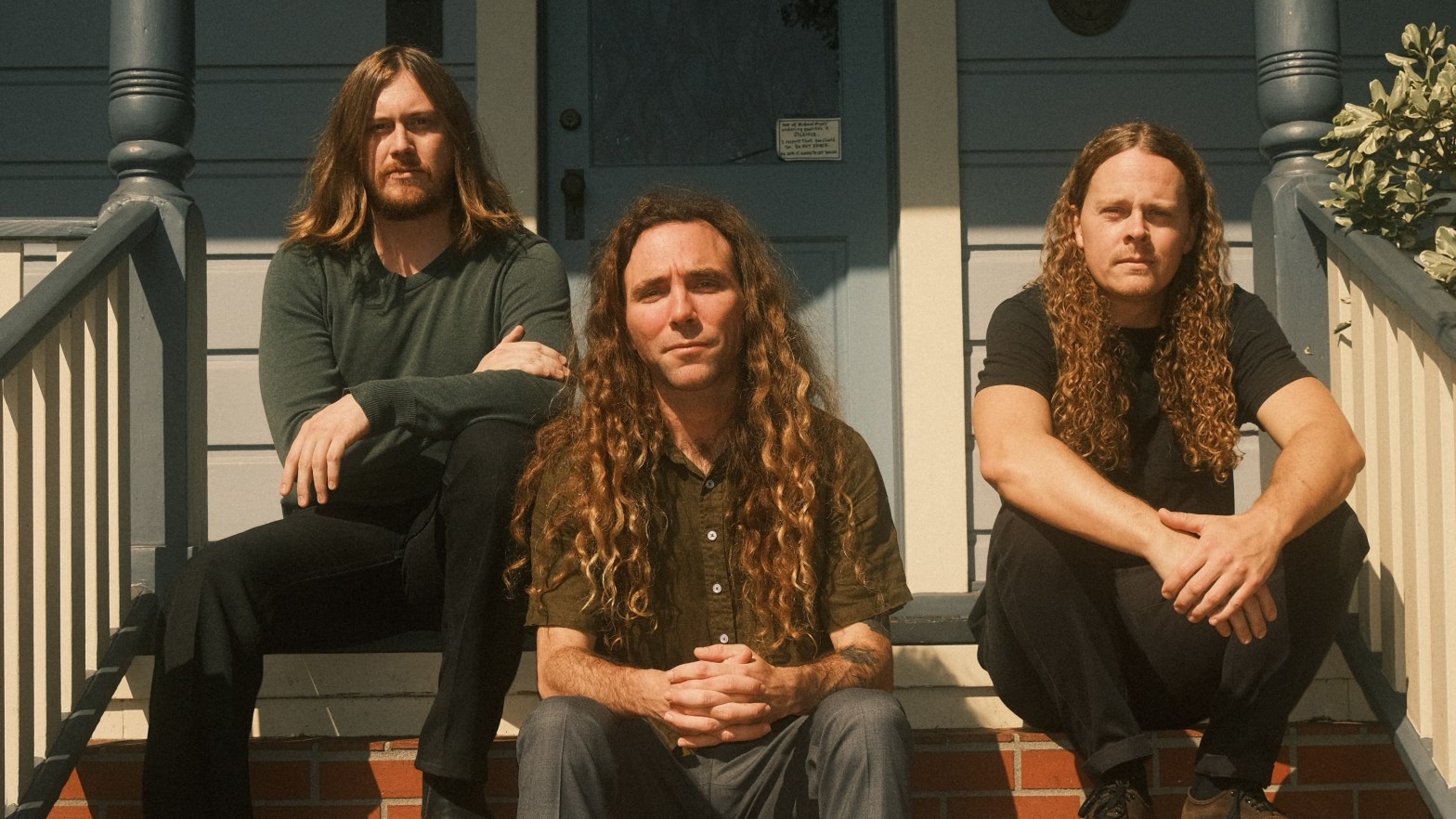
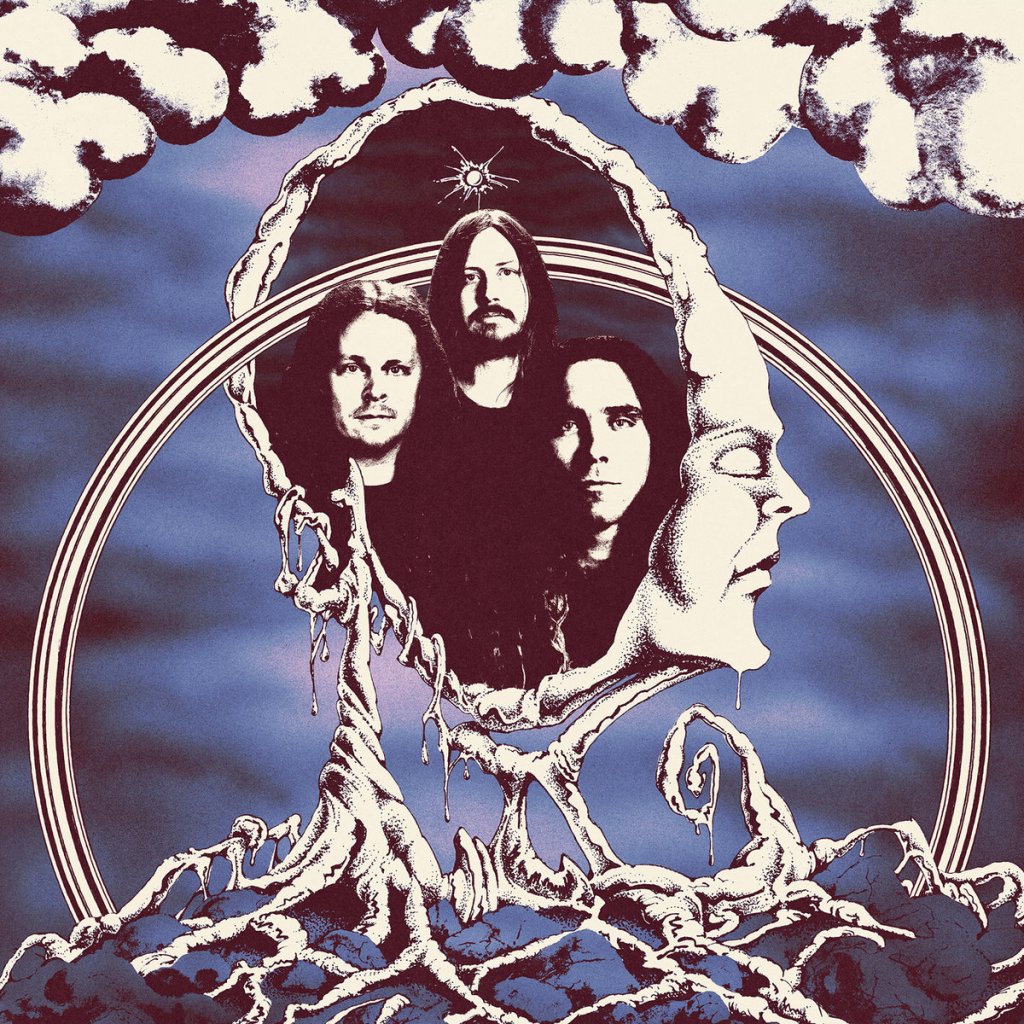
Primitive Ring was a new name to me but on my first listen there was something familiar about their sound I couldn’t put my finger on. Of course, it was the mighty Bert Hoover who regular readers will know via Hooveriii, the band that makes colourful, fun and raucous psych rock. Primitive Ring gives him another outlet built around three players who sound as if they were fated to end up in the same room. Hoover takes bass and vocals, Charles Moothart of Fuzz, GOGGS and Ty Segall’s orbit brings guitar and vocals, while Jon Modaff sits behind the kit with that loose, heavy handed confidence you need in a trio like this. Their self-titled debut, Primitive Ring, arrives via In The Red Records after a run of seven-inch singles across Greenway, In The Red, Reverberation Appreciation Society and Fuzz Club, and you can hear that in the grooves of this record. It feels like it’s been fully tested in a live setting.
The album sounds like three musicians reaching for the simple pleasure of playing loud together, then finding stranger turns inside that simplicity. It has the heft of heavy psych, the nerve of garage rock and the big boned swing of old power trio records, yet it stays rooted in the present because the playing feels hungry rather than nostalgic. Let’s drop the needle and dive in.
‘Fire And Brimstone’ gets the job of opening the gate with guitar lines bubbling around the drums before the whole thing locks into a blues-stained psych rock charge. The vocals give it a strange theatrical lift, especially against the thickness of the riffing. The violins that punctate sections add another sonic flavour. This song was built to make an entrance; the sort of opener that tells you the band has arrived and they ain’t taking no prisoners.
Keeping things growling along next is ‘The Last Goldmine’. The low end sits right at the front, giving the guitars a platform to snarl, chatter and cut through without losing the body of the song. Hoover’s bass has a lovely stubborn quality here, sitting deep in the mix while still leading the charge. The drums do a lot of the heavy lifting, with Modaff making the song feel live without letting it spill out of frame. There is a clear sense of a trio listening to one another, each player leaving just enough room for the next jab, fill or vocal line to make its mark.
By the time ‘Lies From The Other Side’ comes in, the album is well into its stride. This is where Primitive Ring hit the accelerator, with the guitars moving in tight little coils while the rhythm section keeps the pressure high. The vocal delivery has a sneer running through it, yet the track remains song focused. This track has that wired single energy, the sort of tune that makes sense on stage because every part of it feels built to send the mosh pit into overdrive.
‘Paid’ brings a funkier stomp. The guitar tone sounds thick and dry, with enough bite around the edges to keep it from becoming too clean. There is a nice heaviness in the riffs that punctuate the chorus sections and the way the band lets the rhythm hang for a split second before the next hit arrives is proper cool. We hear a sprinkle of Hammond organ for the first time too. This is where the album narrows its eyes, moving from the cosmic sparks of the opener into something earthier and more direct.
‘Sold A Lie’ pairs that directness with one of the record’s sharper rhythmic drives. The song sounds like it is constantly leaping and lurching forward, helped by a bass part that refuses to sit still and guitar lines that keep you on your toes. Pervading it all is a tense, slightly paranoid feel, as if the title has seeped into the arrangement itself. The track takes that three-piece dynamic and pushes it to its limits.
‘Heads Will Roll’ arrives with the kind of title that practically demands a volume knob set to eleven, and Primitive Ring oblige. This one has the pace and muscle of a band who know exactly how to set a crowd alight. The beat feels urgent, the guitar work has a serrated edge, and the vocal sits right in the middle of it with a grin you can hear. It is one of the album’s clearest shots of heavy psych rock pleasure, all forward motion and sharp corners. Primitive Ring hit the riff, push it hard and let the trio chemistry do the talking.
‘Call Me What You Please’ gives the record a little more mischief. The guitar moves with a restless quality, travelling up and down the neck as if Moothart is arguing with himself. That little flicker of character gives the song a playful edge, especially against the dirtier swing of the rhythm section. The vocal feels loose in the best way, with enough attitude to sell the title while still serving the song. Every instrument sounds slightly scuffed, and that roughness suits the band beautifully.
Up next ‘Griefsong’ is my favourite moment on the record, and it earns that place by changing the emotional temperature without stepping outside the album’s world. It has Hoover’s fingerprints all over it. That guitar harmony riffage, the walking bass and melodic vocal all point to him as its creator. That said, for me its Moothart who is the hero of the hour here. He really makes his guitar talk, weep and wail where needed and it’s just mind blowing to listen to.
‘The Callous Man’ stretches out and gives the album its biggest room to breathe. It begins with Hoover’s rolling bass and Modaff’s loose, jazzy movement around the kit, and that opening is a gift because it lets the groove gather itself before the guitars start throwing sparks. The vocals feel shadowy, the riffing grows heavier with each pass, and when the guitar solo arrives it has that wild flash. Lyrically, the song circles a dark figure, someone manipulative and dangerous, and the music gives that idea a proper body. You can almost see him standing at the edge of the room, smiling while the band tightens the screws.
‘Our Oblivion’ moves into a different shade again, opening the door to Zep-tinged acoustic guitar, keys and lighter percussion while keeping the album’s sense of weight intact. The arrangement feels careful, it builds sure, but Primitive Ring let it build slowly, keeping the song grounded in mood and texture rather than chasing a massive release. That restraint gives ‘Our Oblivion’ a strange beauty. After the heavier tracks before it, this one feels like the smoke clearing just enough to see what’s next.
What’s next is the end. ‘Golden’ closes the album by returning to a song from the band’s first run of seven-inch releases and giving it a fuller life. The strings and piano bring a warmer glow to the track, while the band keep enough rough edge in the performance to stop it feeling too polished. It has a lovely end of night feeling. As a closer, it brings the album back to the idea of a band still becoming itself. It feels settled, generous and aware of where Primitive Ring might head next.
Primitive Ring works because it understands the thrill of three people making a great deal of noise just for the hell of it. The album has riffs you can feel in your chest, drums that keep the room moving, bass lines that act like a second lead voice and vocals that carry just the right amount of bite. It also has more range than the first blast might suggest, with ‘Griefsong’, ‘The Callous Man’, ‘Our Oblivion’ and ‘Golden’ giving the second half a richer emotional weight. For a debut, it already feels lived in. For a new band made from seasoned players, it feels fresh enough to make you want to follow wherever they go next. By the end, Primitive Ring feels less like a first statement and more like the sound of three players who instinctively know each other inside and out.
Primitive Ring is out now via In The Red Records. You can check it out over on the Primitive Ring Bandcamp page.
You can follow Primitive Ring on social media here…
Discover more from Static Sounds Club
Subscribe to get the latest posts sent to your email.

